NeelakshSaxena/Drishti / .agents/skills/adaptive
adaptive
VerifiedInstructions to make or update an app's UI so that it adapts to different Android devices including phones, tablets, foldables, laptops, desktop, TV, Auto and XR. It includes how to handle different window sizes, pointing devices (such as mouse) and text entry devices (such as keyboard) using the Compose MediaQuery API. It also covers multi-pane layouts using Navigation3 Scenes, adaptive UI components (such as buttons) with varying target sizes, and adaptive layouts (including navigation areas - nav rails and nav bars) using the Compose Grid and FlexBox APIs.
references/android/develop/ui/compose/layouts/adaptive/flexbox/index.md
View on GitHub> [!NOTE]
> **Note:** FlexBox is an experimental API and is likely to change in the future. To use it, annotate your code with `@ExperimentalFlexBoxApi`. Please file any issues or feedback on the [issue tracker](https://issuetracker.google.com/issues/new?component=1876021&title=%5BFlexBox%5D).
[`FlexBox`](https://developer.android.com/reference/kotlin/androidx/compose/foundation/layout/FlexBox.composable#FlexBox(androidx.compose.ui.Modifier,androidx.compose.foundation.layout.FlexBoxConfig,kotlin.Function1)) is a container that lays out items in a single direction. It can
resize, wrap, align, and distribute space among items to optimally fill the
available space. It's a useful layout for different sized items and for resizing
items when the available space changes.
With `FlexBox`, you can:
- Control how items grow and shrink to fill the available space
- Wrap items onto new rows or columns when there isn't enough space for them
- Distribute extra space between items using convenient presets
## When to use FlexBox
`FlexBox` is usually used to display a small number of items *within* an
overall screen layout. For an overall screen layout,
`Grid` is usually a better choice. `FlexBox` does not support lazy-loading of
items. To display large numbers of items, use [lazy lists and grids](https://developer.android.com/develop/ui/compose/lists). If you
need to wrap items, use `FlexBox` instead of `FlowRow` and `FlowColumn`.
## Terminology and concepts
> [!IMPORTANT]
> **Key Point:** `FlexBox` is heavily influenced by the [CSS Flexible Box Layout specification](https://www.w3.org/TR/css-flexbox-1/) and has almost identical concepts, terminology, and behavior. If you're familiar with `display: flex`, you'll find `FlexBox`'s properties and behavior almost identical.
`FlexBox` lays out its items in either horizontal or vertical *lines* . This
direction of these lines establishes the *main axis* . 90 degrees to the main
axis is the *cross axis* . The length of the `FlexBox` along the main axis is
known as the *main size* . The corresponding cross axis length is known as the
*cross size* . These sizes and axes form the basis of `FlexBox`'s behavior.
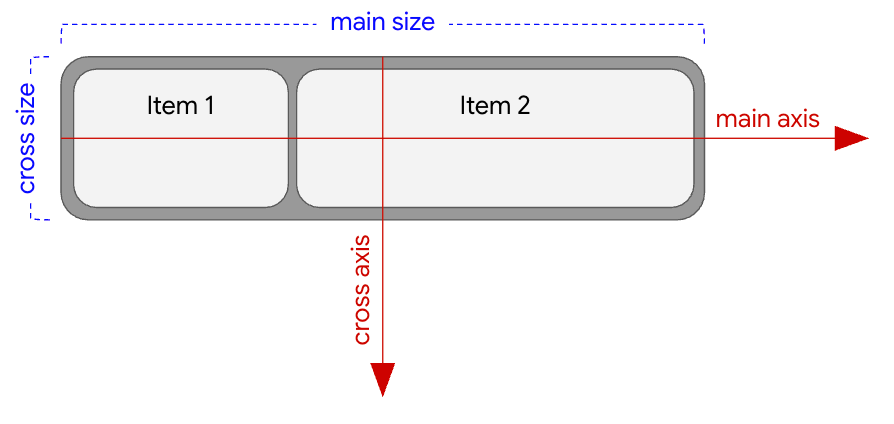 **Figure 1.** Axes and sizes when the `FlexBox` direction is `Row`. 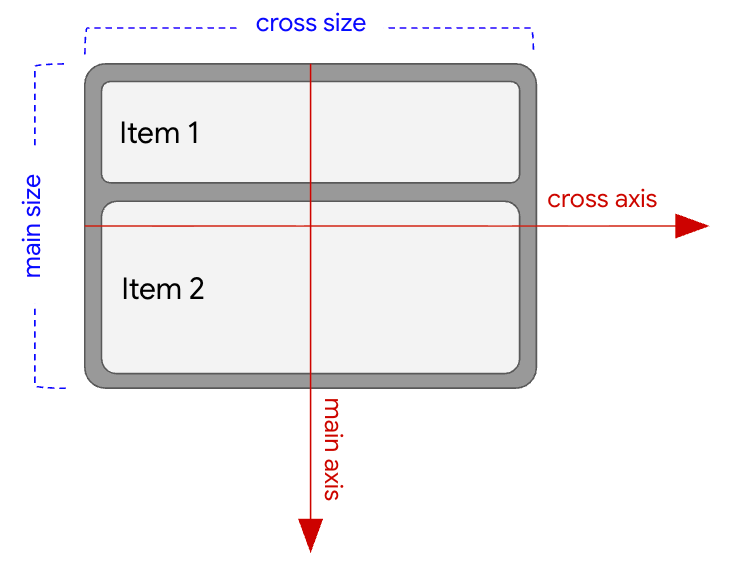 **Figure 2.** Axes and sizes when the `FlexBox` direction is `Column`.
<br />
### Apply properties
You can apply `FlexBox` properties in two ways:
- To the `FlexBox` container using `FlexBox(config)`
- To an item inside the `FlexBox` using `Modifier.flex`
| **Container properties (`config`**) | **Item properties (`Modifier.flex`**) |
|---|---|
| - `direction` - the item layout direction - `wrap` - whether to wrap items if the **main size** is insufficient - `justifyContent` - how to **distribute** items along the **main axis** - `alignItems` - how to **align** items along the **cross axis** - `alignContent` - how to distribute extra space from the **cross size** when there are multiple lines - `rowGap` / `columnGap` - adds space between items and lines See [Set container behavior](https://developer.android.com/develop/ui/compose/layouts/adaptive/flexbox/container-behavior) for more information about these properties. | - `basis` - the size of the item before any extra space from the **main size** is distributed - `grow` - the share of extra space from the **main size** that this item should receive - `shrink` - the share of space deficit from the **main size** that this item should receive - `alignSelf` - how to distribute extra space from the **cross size** to this item, overrides `alignItems` - `order` - controls the layout order See [Set item behavior](https://developer.android.com/develop/ui/compose/layouts/adaptive/flexbox/item-behavior) for more information about these properties. |
### Understand the `FlexBox` layout algorithm
One of `FlexBox`'s most powerful features is its ability to resize its children
to best fit the space available to it. Understanding how `FlexBox` does this can
help you set `FlexBox` properties to optimize your UI for all possible sizes.
`FlexBox`'s layout algorithm works in the following way:
1. **Calculate child base size** : Use the child's [`basis` value](https://developer.android.com/develop/ui/compose/layouts/adaptive/flexbox/item-behavior#set-initial-size)
to calculate its initial size along the main axis before any extra space is
distributed.
2. **Sort the children** : Sort the children by their [`order`](https://developer.android.com/develop/ui/compose/layouts/adaptive/flexbox/item-behavior#item-order) values, if
present.
3. **Build lines** : For each child, check if its initial size plus
[`gap`](https://developer.android.com/develop/ui/compose/layouts/adaptive/flexbox/container-behavior#add-gaps) will fit into the remaining space on the current line.
If so, place this child into the line. If not, place it onto a new line if
[wrapping is enabled](https://developer.android.com/develop/ui/compose/layouts/adaptive/flexbox/container-behavior#wrap-items), or place the item into the current line
where it will overflow (it will be partially obscured by the edge of the
container).
4. **Align or resize items in the main axis** : For each line, distribute extra
space *to* or between items by [resizing](https://developer.android.com/develop/ui/compose/layouts/adaptive/flexbox/item-behavior#item-size) or
[aligning](https://developer.android.com/develop/ui/compose/layouts/adaptive/flexbox/container-behavior#main-axis) them.
5. **Align or resize items in the cross axis** : For each line, distribute extra
space to or between items and lines by [stretching or aligning
them](https://developer.android.com/develop/ui/compose/layouts/adaptive/flexbox/container-behavior#cross-axis).
Now that you're familiar with `FlexBox` concepts, see [Get started](https://developer.android.com/develop/ui/compose/layouts/adaptive/flexbox/get-started) to
create a basic `FlexBox`.Related skills
| Skill | Stars | Updated | Works with | Status | Install |
|---|---|---|---|---|---|
| brainstormingobra/superpowersYou MUST use this before any creative work - creating features, building components, adding functionality, modifying behavior, or planning anything new, in software or out of it (a talk, a business, a renovation). | Stars: 322k | Updated | Claude CodeCodex | Verified | Install |
| brand-guidelinesanthropics/skillsApplies Anthropic's official brand colors and typography to any sort of artifact that may benefit from having Anthropic's look-and-feel. Use it when brand colors or style guidelines, visual formatting, or company design standards apply. | Stars: 198k | Updated | Claude CodeCodex | Verified | Install |
| frontend-designanthropics/skillsGuidance for distinctive, intentional visual design when building new UI or reshaping an existing one. Helps with aesthetic direction, typography, and making choices that don't read as templated defaults. | Stars: 198k | Updated | Claude CodeCodex | Verified | Install |
| mcp-builderanthropics/skillsGuide for creating high-quality MCP (Model Context Protocol) servers that enable LLMs to interact with external services through well-designed tools. Use when building MCP servers to integrate external APIs or services, whether in Python (FastMCP) or Node/TypeScript (MCP SDK). | Stars: 198k | Updated | Claude CodeCodex | Verified | Install |